Of course, the reality is that most customers will begin messaging a business on WhatsApp long before they ever fill in a contact form. A great WhatsApp CRM software will take those channels of random conversations and combine them into a shared inbox, a tracked sales funnel, and automated response messages.
This article compares five of the most searched WhatsApp CRM Platforms in 2026: WATI, Interakt, Kommo, HubSpot and WaliChat/Picky Assist. Because each one is made for a different sort of team, we’ve divided precisely who each solution will work for.
Quick Overview
WATI is suitable for chatbot automation, Interakt for ecommerce brands, Kommo for sales pipelines, HubSpot for end to end CRM integration, while WaliChat and Picky Assist are best for WhatsApp-first workflows and customer engagement.
Top 3 Picks at a Glance
| Tool | Best For |
| WATI | Automation-heavy support teams |
| Interakt | Ecommerce and Shopify brands |
| Kommo | Sales-driven teams |
Understanding WhatsApp CRM Software
A WhatsApp business CRM is a tool that links the WhatsApp Business API to a single, shared dashboard, allowing teams to operate customer conversations without the need for one person’s phone. All in one messaging and CRM tools enable businesses to keep track of contacts, follow up on potential clients, automate interactions, etc. With a WhatsApp business CRM, you get team inboxes, automated chatbots, pipelines, customer segmentation, order updates and chat history.
This simplifies administration of WhatsApp at scale and at the same time provides teams with deeper knowledge of each conversation with a customer.
Key Benefits for Sales and Support Teams
WhatsApp CRM tools are helpful for businesses that want to centralise all customer conversations in one place and improve the performance of sales and support teams. Instead of juggling between multiple devices and apps, reps can refer to a shared inbox. Automations are a great way to automate repetitive questions, reminders, and follow ups, led tracking is a great way for a sales rep to see where a prospect is in the sales funnel.
The ability to assign conversations to individual agents also makes teams more accountable and helps speed up response times. Payments, ecommerce and business integrations help teams create seamless customer experiences.
Our Criteria for Comparing These Platforms
We assessed each platform against the key features needed for successful WhatsApp customer management, including WhatsApp automation, CRM tools, chatbot versatility, shared inbox effectiveness, ecommerce integrations, sales pipeline management, and team collaboration.
Additionally, we looked at the following aspects of the platforms we reviewed: analytics and reporting features, contact management, integration capabilities, scalability, pricing schemes and general ease of use. These attributes allow us to suggest which types of organisations each platform is appropriate for-whether small businesses, expanding ecommerce brands, sales teams or larger entities handling high volumes of customer conversations.
Best WhatsApp CRM Software Compared
| Software | Rating | Best For | Key Features | Starting Price |
| WATI | 4.6/5 | Chatbot automation | No-code bots, shared inbox, broadcast | $59/mo (Growth) |
| Interakt | 4.0/5 | Ecommerce brands | Cart recovery, COD confirmation, Shopify sync | ₹999/mo (Starter) |
| Kommo | 4.1/5 | Sales pipelines | Kanban pipeline, Salesbot, multi-channel inbox | $15/user/mo (Base) |
| HubSpot | 4.4/5 | Full CRM integration | Native WhatsApp on Pro tiers, unified contact timeline | Free CRM; WhatsApp needs Pro ($90/user/mo) |
| WaliChat / Picky Assist | 4.3/5 | Multi-number workflows | Multi-agent inbox, broadcast, automation | $14/mo (Picky Assist Basic) |
5 Best WhatsApp CRM Software
1. WATI
Rating: 4.6/5
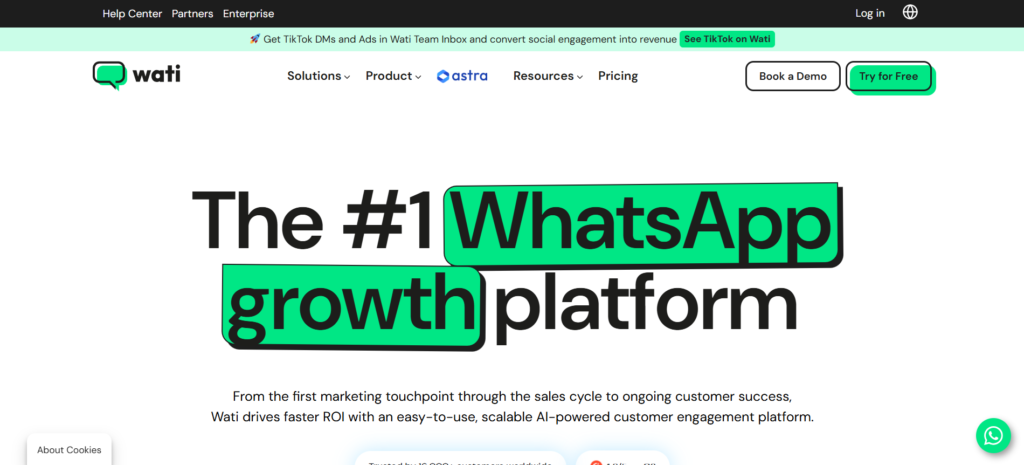
WATI has focused its brand almost exclusively on automation; its no code chatbot builder allows support and sales reps to create multi step conversation flows without a single line of code.
What WATI has going for it is depth, workflow automation, template management, API integrations for truly complex support and sales scenarios-not just auto resplies. The flip side is a tiered pricing model-the subscription is usually the least significant part of the monthly bill once per-message charges (roughly 20% above Meta’s rates) and added agent seats are factored in.
Key Features:
- No-code chatbot builder with multi-step conversation flows
- Shared team inbox with role-based agent assignment
- Broadcast messaging with delivery and response analytics
- CRM and API integrations for syncing WhatsApp data externally
- WhatsApp Green Tick verification assistance
Pros:
- Most capable chatbot automation in this category
- Analytics dashboards for tracking response times and campaigns
- Strong integration options for connecting to existing CRMs
- Well-established platform with a large user base
Cons:
- Real monthly cost often runs well above the advertised base price
- Entry-tier user caps (3–5 users) feel restrictive quickly
- Roughly 20% markup on Meta’s official message rates
- Additional agent seats get expensive on higher tiers
Pricing:
- Growth: ₹2,699/month — 3 users
- Pro: ₹5,799/month — 5 users
- Business: ₹16,799/month — 5 users
2. Interakt
Rating: 4.0/5

Interakt is designed for ecommerce flows and includes tools such as abandoned cart recovery and cash on delivery order confirmation to help D2C brands reduce RTO losses. It’s also a native Shopify app.
This makes Interakt the clear winner here for WhatsApp CRM for ecommerce brands in particular, as many features, like double-confirming COD orders, directly help protect margins. The issue is that the subscription plus wallet model means the monthly cost really gets hit hard by message volume and not the plan level.
Key Features:
- Automated abandoned cart recovery messages
- COD order double-confirmation to reduce RTO
- Native Shopify integration with order and shipping updates
- Shared team inbox for WhatsApp and Instagram
- Bulk broadcast campaigns for product launches and discounts
Pros:
- Purpose-built for D2C and ecommerce workflows
- Low entry-tier subscription cost (₹999/month)
- Direct Shopify integration without third-party middleware
- WhatsApp Blue Tick support for brand credibility
Cons:
- Real bills are often driven by message volume, not the subscription
- Marketing and Sales CRM features require separate subscriptions
- Instagram-only access on the cheapest monthly tier
- Message charges include a reported markup of roughly 12–15%
Pricing:
- Starter: ₹3,499/qtr
- Growth: ₹7,699/qtr
- Advanced: ₹10,499/qtr
- Enterprise: On request
3. Kommo
Rating: 4.1/5
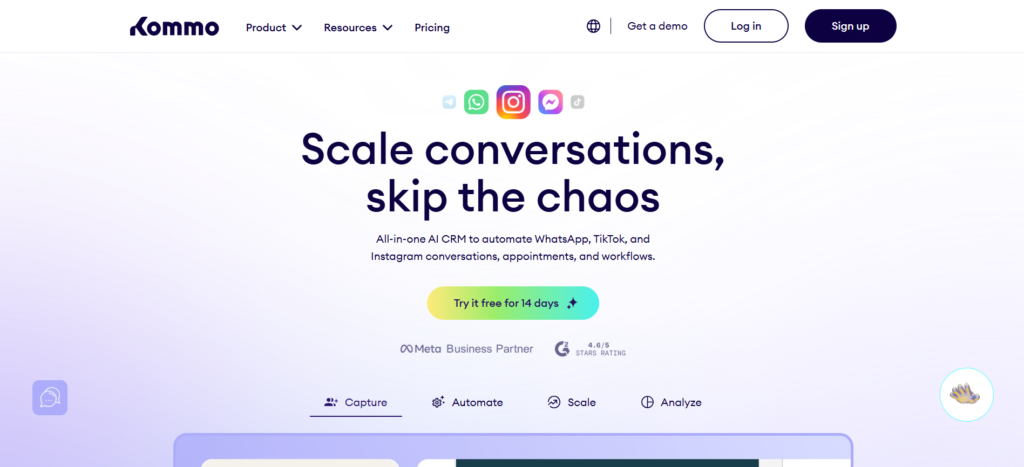
The Kommo system is built around a visually presented Kanban pipeline, where each WhatsApp message or chat is a potential deal. Messages that come in from WhatsApp, Instagram, Telegram, or other sources all go to a single inbox, associated with this pipeline.
This makes Kommo the best suited at this stage for sales pipeline, management as its Salesbot automation can automatically qualify your leads and progress them through stages and conversions, something that general messaging tools such as WATI or Interakt are not designed to do.
Key Features:
- Visual Kanban pipeline for tracking deals through sales stages
- Inbox unification on WhatsApp, Instagram, Messenger and Telegram
- No code Salesbot for automated lead qualification
- AI Agent for handling inquiries and recommending products
- Over 20 integrations, including Google Ads and QuickBooks Online
Pros:
- Genuinely sales-focused, not just a messaging inbox
- Multi-channel messaging in one unified view
- Strong automation for lead qualification and follow-up
- Transparent per-user pricing with no hidden platform fees
Cons:
- Per-user pricing adds up quickly for larger teams
- Base plan caps active leads and limits automation
- Prices are rising from September 2026 ($15→$25, $25→$35 per tier)
- Requires a Six month minimum subscription commitment
Pricing:
- Basic: 1,436 Rs.per user/month — 2,500 leads
- Advanced: ₹2,393/user/month — 5,000 leads
- Pro: ₹4,307/user/month — 10,000 leads
- Enterprise: Custom pricing
4. HubSpot
Rating: 4.4/5
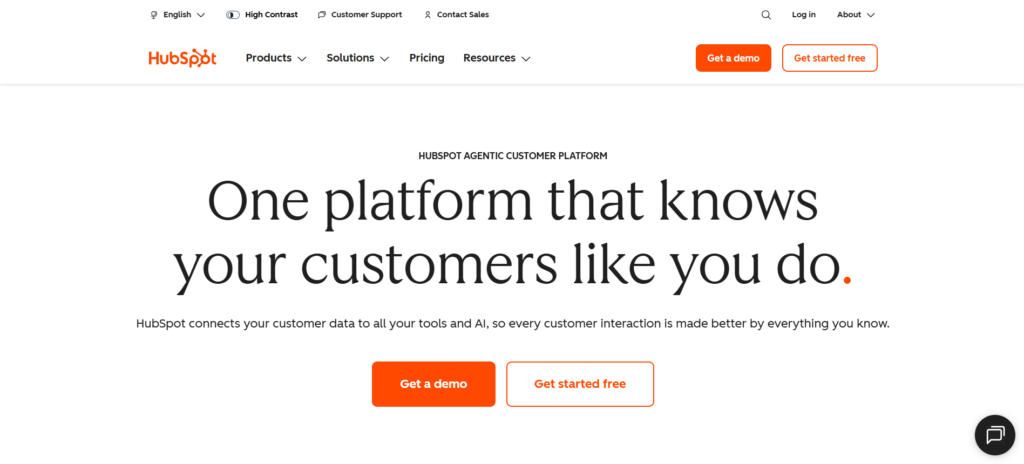
HubSpot is a little different to the other options here – it’s a CRM platform that has WhatsApp integrated as a channel rather than the main focus of the service. All WhatsApp chats are integrated into the contact timeline as well as emails, calls, and deal history.
This makes HubSpot a no-brainer for those teams seeking full CRM integration rather than a separate WhatsApp tool bolted onto their process. The catch: native WhatsApp is not on the free or Starter levels – it requires a move to a Professional-level Hub, a huge leap in cost for smaller teams.
Key Features:
- Native WhatsApp Business API integration synced to the contact timeline
- Unified free CRM covering contacts, deals, and basic ticketing
- Marketing, Sales, and Service Hubs available as connected modules
- Automation workflows tied to WhatsApp message triggers
- Reporting across WhatsApp alongside email and other channels
Pros:
- Deepest CRM data model of any tool in this category
- Free CRM tier is genuinely usable for small teams
- WhatsApp conversations sit alongside full customer history
- Scales well for teams that need marketing, sales, and service together
Cons:
- WhatsApp is locked behind Professional-tier Hubs, not Starter
- Jumping to Professional is a $400–$600/month cost increase for most teams
- Only one WhatsApp number is supported per portal natively
- Meta message fees apply on top of HubSpot’s subscription cost
Pricing:
- Free: ₹0/month — Up to 2 users
- Starter: From ₹585/month/seat — 1,000 marketing contacts
- Professional: From ₹66,697/month — 3 Core Seats
- Enterprise: From ₹300,000/month — 5 Core Seats
5. WaliChat / Picky Assist
Rating: 4.3/5
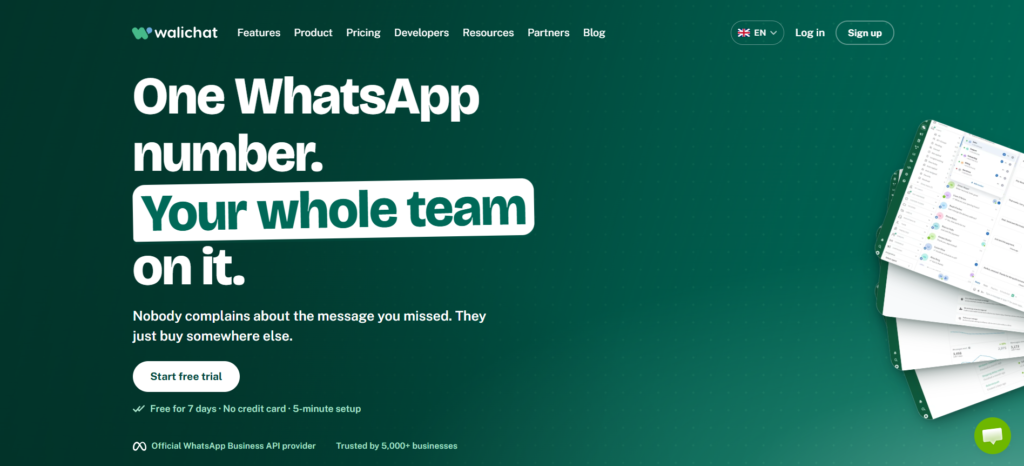
If you want to manage WhatsApp well and don’t need a sprawling CRM built on top of it, WaliChat and Picky Assist are two dedicated, WhatsApp first tools. WaliChat has a common multi-agent inbox and broadcast campaigns, while Picky Assist adds a small CRM, chatbot builder and multi-channel automation in WhatsApp, Facebook & email.
Both tools are designed with supporting several WhatsApp numbers and agents running concurrently in mind. They are a good solution for multi-number WhatsApp workflows – such as running several branches or storefronts from different numbers. They sacrifice some CRM capability for ease of onboarding and lower entry prices.
Key Features:
- Shared inbox supporting multiple WhatsApp numbers simultaneously
- Broadcast campaigns with list segmentation (WaliChat)
- No-code chatbot builder and conversational funnels (Picky Assist)
- Lightweight CRM system along with contact tagging and interaction history
- Integration with Zapier, Zoho CRM, and Zendesk
Pros:
- Really made for WhatsApp rather than WhatsApp as an add on
- Affordable entry pricing compared to full CRM platforms
- Good fit for multi-branch or multi-agent operations
- Both offer free trials with no credit card required
Cons:
- Less deep CRM and reporting than HubSpot or Kommo
- Additional agent seats add extra monthly cost
- Smaller integration ecosystem than larger platforms
- No permanent free plan on either tool
Pricing:
- Professional: $39.90/month
- Business: $69.90/month
- Enterprise: $99.90/month
Finding the Best Fit for Your Team
The best WhatsApp CRM will depend on your type of business and your team’s workflow. WATI is suitable for businesses that require more comprehensive automation, Interakt is a good choice for ecommerce businesses that want to engage customers through multiple communication channels, and Kommo is a good choice for sales teams working with leads and pipelines.
HubSpot is ideal if you need more features within your CRM. If you run several WhatsApp numbers and want more workflows, then you could look at WaliChat or Picky Assist.
WhatsApp CRM Features to Compare
If I were to compare different WhatsApp CRM, I would choose one that provides the necessary tools for interacting and selling. Core features should include integration with WhatsApp Business API, automation via chatbots, team inboxes for collaboration, lead and contact management and segmentation, sales funnels, broadcasting and messaging, integrations with ecommerce platforms, and reporting and analytics. Automation triggers, customer assignment, follow up functionalities, integrations and reporting are also some of the key features to look for. A CRM such as this would enable your team to contact each other easily and stay organised.
WhatsApp CRM and Traditional CRM: Key Differences
A WhatsApp CRM is characterised by conversation based interactions rather than forms and emails, so customer data is captured differently. Traditional CRMs are centred on structured records and omnichannel features; WhatsApp CRMs are focused on live messaging, lead qualification within live chats, and sales automation driven by chat activity.
For businesses managing conversations across multiple social channels, social media monitoring can complement these CRM workflows by tracking customer mentions and interactions.
Most team coordination is done around assigning and replying to live chats rather than internal deal notes.
Understanding WhatsApp CRM Costs
WhatsApp CRM pricing can depend on the features, number of users, automation needs, and number of messages sent. Some platforms offer free CRM plans, like the free plan from HubSpot, but when using the free plan, there might be limitations to use WhatsApp. Other platforms depend on a monthly subscription. Examples are WATI, Interakt and Picky Assist.
Per-user pricing might be relevant for Kommo and HubSpot. When estimating the total budget, companies also need to take into account the WhatsApp conversation costs, message fees, vendor markup and custom enterprise pricing.
Steps for Selecting a WhatsApp CRM
Determining which WhatsApp CRM to select for your business is also about your communication and sales needs. Understand if you need a customer care, sales, or both oriented solution. Confirm the official WhatsApp Business API access and chatbot automation features. Look for CRM integrations, shared inbox support and ecommerce integrations.
Lastly, compare team seats, message limits, automation capabilities and other WhatsApp fees. Avoid focusing only on subscription plan costs; the total cost of ownership will provide a more comprehensive view of the decision.
Final Verdict
No one-size-fits-all WhatsApp CRM. WATI is best for automation-focused teams, Interakt for ecommerce brands that need to manage customer conversations and orders, Kommo if sales teams want to follow a structured lead management process, and HubSpot if a business needs full CRM integration and wider customer data management. For teams managing multiple WhatsApp numbers, WaliChat and Picky Assist are worth exploring. Compare automation, integrations, team features, scalability, and WhatsApp messaging costs before you decide.
Frequently Asked Questions
1. What is a WhatsApp CRM?
A WhatsApp CRM links the WhatsApp Business API to a common dashboard so that a team can handle conversations, automate replies and have each lead tracked without a common phone.
2. Which is the best WhatsApp CRM software?
It will depend on your priority. Leading for chatbot automation are WATI, Interakt for ecommerce brands, Kommo for sales-oriented teams, HubSpot for businesses that need full CRM integration, and WaliChat or Picky Assist for multi-number and WhatsApp first operations.
3. Can WhatsApp be integrated with a CRM?
Yes. Most existing CRMs like HubSpot, Kommo, or some tools like WATI or Interakt are connected to the official WhatsApp Business API in order to sync conversations, contacts and chat history.
4. What is the best WhatsApp CRM for ecommerce?
Interakt is usually the best option for ecommerce, since it offers native Shopify integration targeted at minimising D2C return loss, plus features like recovery of abandoned carts and confirmation of COD orders.
5. Is there a free WhatsApp CRM?
Not completely- HubSpot’s basic CRM is free for any number of users, but the integration into WhatsApp has a paid Professional hub, and Meta pegs a per-conversation fee that applies whether you use it in WhatsApp, in Messenger, or any other app.