
Anytime you attempt to optimise the experience for your visitors without data to support your decision, you are almost always mistaken. You need an A/B testing platform to test real-world solutions on real-world traffic to decide what works best-and what doesn’t. From checkout flows, to pricing pages, to trying to optimise the whole product experience-you need the right tool to take intuition out of the equation, and put the data back in.
This year we took a closer look at six of the best experimentation platforms-testing capacity, personalisation options, analytics tools, and cost. Here are our 3 favourites to start with until we get into the full review.
Top 3 Picks at a Glance
The best AB testing tools fit different needs; Optimizely is best for enterprises, VWO for Conversion Rate Optimisation, and Kameleoon for AI personalisation. AB Tasty is best for ecommerce, Amplitude for product teams, and GrowthBook for open-source solutions.
| Platform | Best For |
| Optimizely | Enterprise experimentation |
| VWO | CRO |
| Kameleoon | AI personalization |
Understanding A/B Testing Software
A conversion rate optimisation tool allows companies to conduct controlled tests to learn what modifications to the website, product or campaign have an impact on key metrics. The software usually provides A/B, split and multivariate testing, as well as personalisation, segmentation, behaviour tracking, session recordings and reporting functionalities.
As assumptions give way to measurable experiments, companies can discover better user experiences, decrease conversion friction, and make decisions they can trust based on visitor and customer actions.
Business Benefits of A/B Testing Platforms
Companies use experimentation platforms to improve conversion rates while avoiding the risk associated with large scale design or product changes. A top notch experimentation platform will allow companies to test headlines, layout, offers, features and customer flows in an A/B testing environment.
It also brings the ability to personalise experiences, segmentation of audiences, campaign measurement and cross discipline decision making. This provides a framework for identifying what works, optimising performance, and continuously improving digital experiences.
Methodology Used to Compare These Tools
We have compared each A/B testing platform using 10 practical elements: testing features, types of experiments supported, visual editing tools, personalisation features, reporting /analytics detail, audience segmentation and targeting, integrations, ease of use, scalability and pricing. We have also compared the official pricing information (where available), as most A/B testing tools tend to have usage-based or custom pricing.
We explored the skills that companies need to be able to quickly implement experiments, understand results and grow their experimentation as their traffic and testing needs expand.
Best A/B Testing Tools Compared
| Tool | Rating | Best For | Key Features | Starting Price | Free Trial/Plan |
| Optimizely | 4.2/5 | Enterprise experimentation | Full-stack testing, feature flags, multi-armed bandits | Custom (from ~$36K/yr) | Demo on request |
| VWO | 4.4/5 | CRO teams | A/B/MVT testing, heatmaps, personalization, SmartStats | ~$314/mo (10K MTU) | 30-day free trial |
| Kameleoon | 4.6/5 | AI personalization | AI-powered targeting, feature flags, server-side testing | From $495/mo | Demo on request |
| AB Tasty | 4.4/5 | Ecommerce engagement | No-code editor, recommendations engine, personalization | Custom (~$45K/yr avg) | Demo on request |
| Amplitude | 4.5/5 | Product experimentation | Native analytics + experimentation, feature flags | Free; Plus from $49/mo | Free tier available |
| GrowthBook | 4.6/5 | Open-source testing | Warehouse-native, Bayesian/Frequentist engines, feature flags | Free (self-hosted); Pro from $20/user/mo | Free Starter plan |
6 Best A/B Testing Tools
1. Optimizely
Rating: 4.2/5
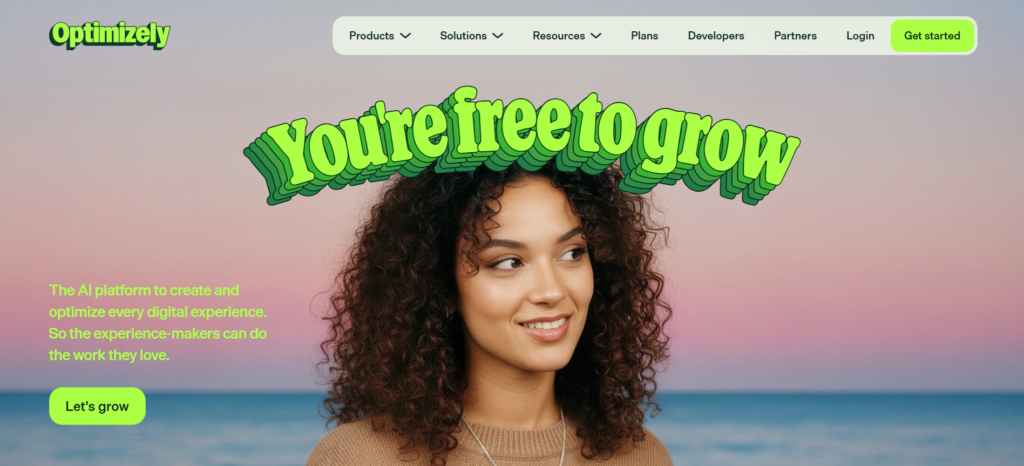
One of the pioneers in the realm of experimentation is Optimizely, whose products serve the purpose of conducting experiments on the web, mobile devices, and server side using one SDK. Its Stats Engine supports numerous statistical engines, including sequential testing, Bayesian and frequentist, enabling teams to select the model most appropriate for their traffic and risk profile. Multi armed bandits dynamically adjust traffic to winning variations when the results are in.
Also included in the broader Optimizely One platform, it offers feature flags, content management, and personalisation to companies looking to experiment in a more extensive digital experience platform.
Key Features:
- Full stack A/B and multivariate testing (web, mobile, server side)
- Multiple statistical engines, including sequential and Bayesian
- Multi-armed bandits for automatic traffic allocation
- Built-in feature flags and rollout controls
- AI agents that review experiments and surface insights
Pros:
- Industry-leading depth for complex, full-stack experimentation
- Strong statistical rigor with flexible testing methods
- Scales well for large, distributed engineering teams
- Part of a broader digital experience ecosystem
Cons:
- Pricing is opaque and requires a sales conversation
- High entry cost, often starting around $36,000/year
- Setup can be complex without dedicated technical resources
- Steeper learning curve for smaller marketing teams
Pricing:
- Optimizely: Custom pricing
- Pricing model: Individually packaged / quote-based
- Public starting price: Not listed
- Free option: Optimizely Rollouts is basically free of charge for basic feature experimentation.
2. VWO
Rating: 4.4/5
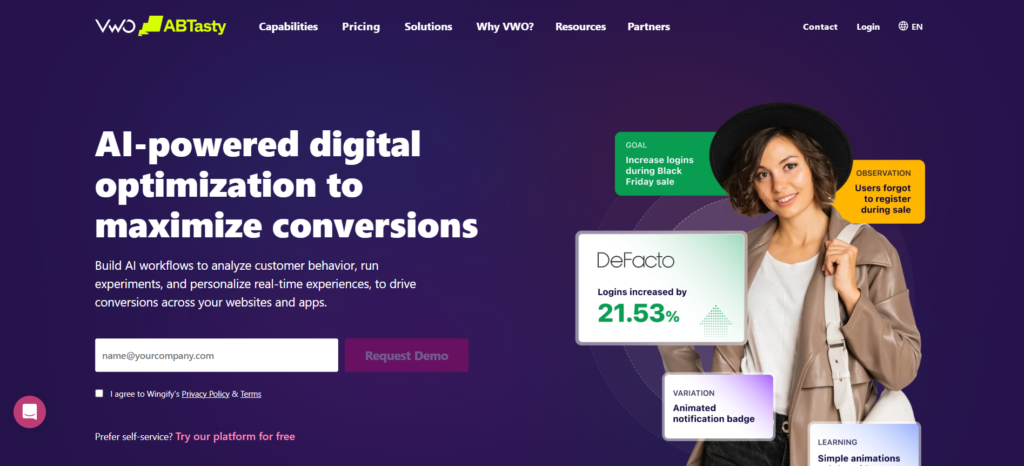
The VWO platform has long been an obvious choice for conversion rate optimisation teams who have all four things under one platform on their wish list. Its visual editor is truly code free, enabling marketers to implement tests and make on page changes without the help of a developer. Since its 2016 acquisition by AB Tasty, VWO now bills itself as an even larger CRO and personalisation suite.
Pricing is also determined by Monthly Tracked Users (MTUs) rather than seats, so the size of the team does not determine price; traffic volume does.
Key Features:
- Drag-and-drop visual editor for code-free testing
- A/B, split, and multivariate testing with SmartStats
- Heatmaps and session recordings built in
- Personalisation and audience targeting
- 50+ integrations, including GA4, Segment, and HubSpot
Pros:
- User-friendly interface, minimal developer dependency
- Strong all-in-one CRO toolkit beyond just testing
- Responsive support with high satisfaction scores
- Broad integration ecosystem
Cons:
- Higher-tier features require custom quotes
- Free Starter plan has been phased out in 2026
- Pricing can climb quickly at higher traffic volumes
- Reporting depth can feel limited for advanced analysts
Pricing:
- Custom, quote-based. No public pricing disclosed.
3. Kameleoon
Rating: 4.6/5
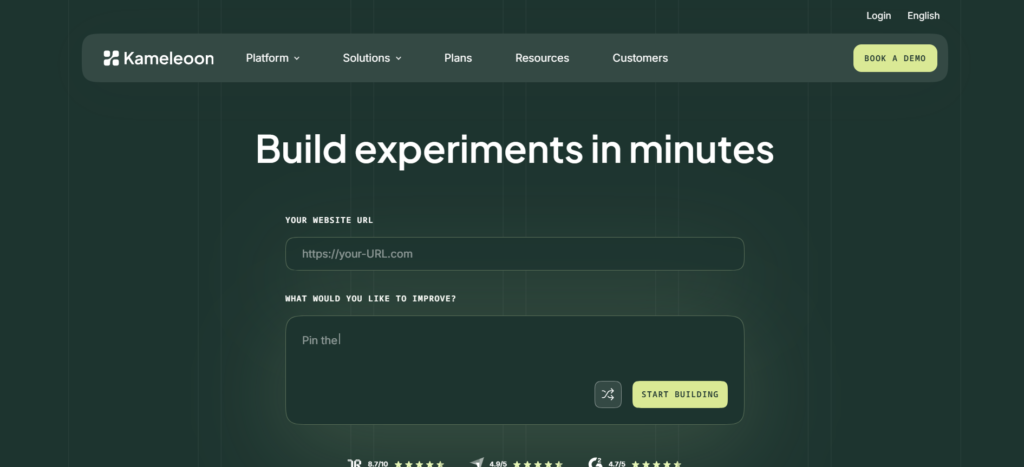
Kameleoon became an AI powered experimentation platform by combining web and server side testing with predictive targeting by automatically deduplicating the target audience by predicted conversion likelihood. It is well suited to many enterprise needs in regulated sectors, with compliance capabilities and feature management added on top of the primary testing engine. It is used by many leading retail and CPG brands in large scale experimentation initiatives.
Kameleoon does something nearly all enterprise competitors fail to: publish a starting price. Buyers can get a feel for the entry cost prior to a sales call. G2 reviewers regularly mention the statistical transparency and helpful customer support while getting setup, although it’s an AI-first feature set that appeals to more technical teams.
Key Features:
- AI-powered predictive analytics audience targeting
- Web and server-side A/B and multivariate testing
- Feature flags and feature management
- Automated insights from experiment results
- Compliance-focused tooling for regulated industries
Pros:
- Published starting price, more transparent than many rivals
- Strong AI-driven personalization and targeting
- Clear, well-regarded statistical reporting
- Responsive onboarding support
Cons:
- Still enterprise-priced compared to lightweight tools
- Smaller review base than more established competitors
- Advanced AI features may be more than smaller teams need
- Best suited to teams with some technical capacity
Pricing:
- Free Trial: Free for 30 days
- PBX Starter: From $495/month
- Enterprise: Custom pricing
- Enterprise: Unlimited experiments and tested traffic
4. AB Tasty
Rating: 4.4/5
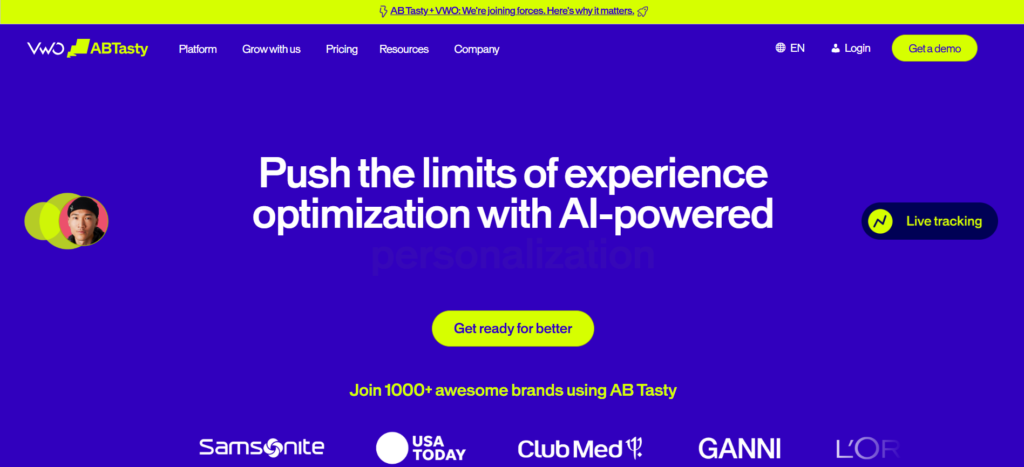
Designed to be easy by marketing teams, the AB Tasty platform comprises a drag and drop editor, a recommendations engine and individualisation tools that are used to manage campaigns without requiring the ongoing support of a developer.
Most frequently seen in ecommerce and retail use cases, where its Emotions AI segmentation and lightweight script allow teams to tailor product pages and search experiences while maintaining site speed.
Key Features:
- No-code drag-and-drop campaign editor
- Product recommendations engine
- EmotionsAI-based audience segmentation
- Feature experimentation and release management
- Lightweight script with minimal performance impact
Pros:
- Very accessible for marketing teams without developer support
- Strong personalization and recommendation tools for ecommerce
- Lightweight, fast-loading implementation
- Solid monitoring and reporting features
Cons:
- No public pricing; requires a sales consultation
- Average contracts run high, often around $45,000/year
- Best value realised only with high testing volume
- Less suited to teams that only need basic A/B testing
Pricing:
- Pricing: Custom pricing
- Based on: Traffic, domains, modules, and implementation scope
- Free Trial: No
- Evaluation: 1-2 week free proof of concept
- Pricing model: Traffic/MAU based
5. Amplitude
Rating: 4.5/5
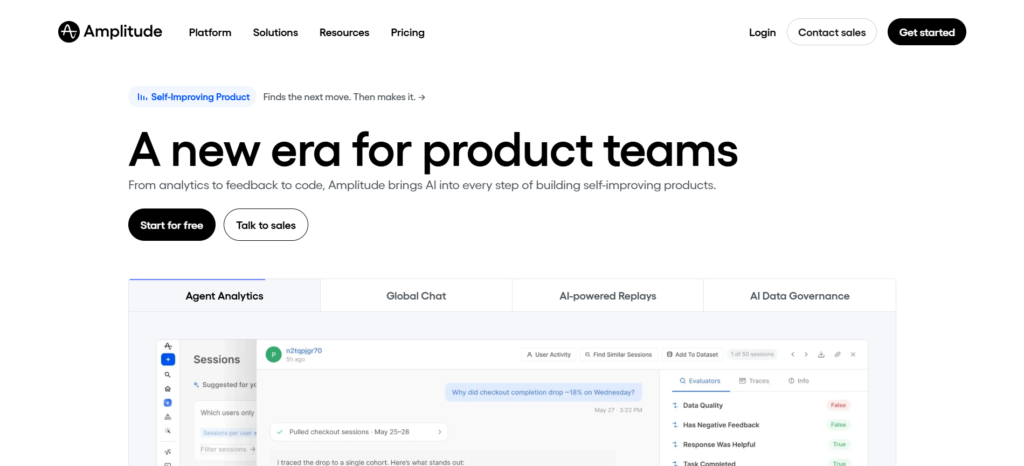
Amplitude takes a product analytics perspective to experimentation, rather than a testing centric one. Since Feature Experimentation and Web Experimentation are hosted on the same platform as Amplitude’s foundational analytics, teams already leveraging its funnel and retention insights can begin testing without having to switch platforms or reinstall code.
Its no-code Web Experimentation editor enables marketers to run experiments without involving engineering, and product teams continue to have access to server-side experimentation.
Key Features:
- Native integration with Amplitude’s product analytics
- No-code Web Experimentation editor
- Server-side Feature Experimentation for engineering teams
- Advanced statistics, including CUPED and multi-armed bandits
- Unlimited feature flags, even on the free plan
Pros:
- Seamless workflow for teams already using Amplitude analytics
- Genuinely useful free tier with real experimentation features
- Strong statistical infrastructure usually reserved for enterprise tools
- Self-serve testing reduces reliance on engineering
Cons:
- Costs scale quickly with event and user volume
- Full Feature Experimentation gated behind Growth+ plans
- Can be 2-5x pricier than lighter analytics-first competitors
- Best suited to teams already invested in the Amplitude ecosystem
Pricing:
- Free: $0, up to 2M events/month
- Plus: Starts at $0; first 2M events/month free
- Growth: Custom, event based pricing
- Enterprise: Custom, event based pricing
6. GrowthBook
Rating: 4.6/5
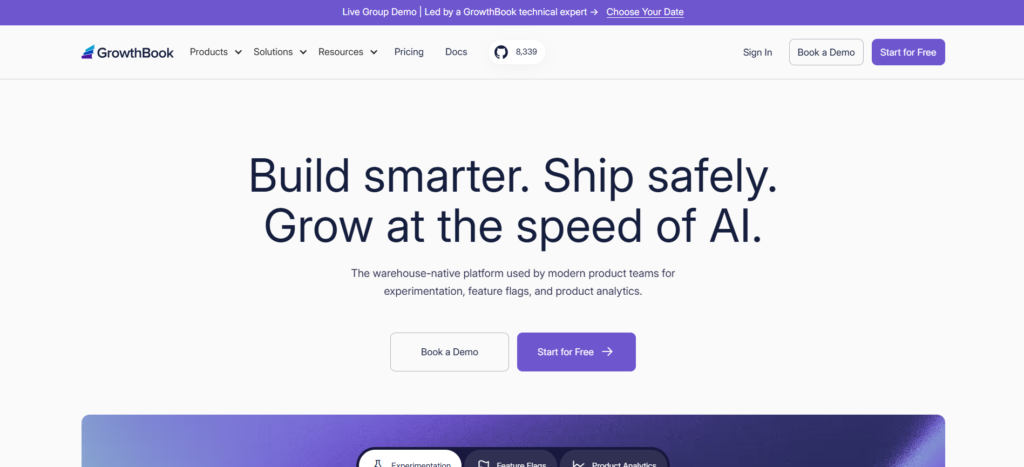
GrowthBook the other way around! It’s warehouse native and open source, so it connects directly to your current data warehouse (Snowflake, BigQuery, Redshift, etc.), so its experiment outcomes are computed on your data directly and not transmitted to a third party.
Offers both Bayesian and Frequentist statistical engines with CUPED and sequential testing, and lightweight SDKs that evaluate feature flags locally with very little performance impact. Self-hosting is entirely free under open source licensing, which makes it a favourite of technical teams who want full control and no per seat tax.
Key Features:
- Warehouse-native experiment analysis
- Bayesian and Frequentist statistical engines
- Lightweight, locally-evaluated feature flags
- Visual A/B test editor for no-code experiments
- Fully open source, self hostable under MIT license
Pros:
- Free to self-host with no usage limits
- Strong statistical rigour comparable to enterprise tools
- Full data control since it runs on your own warehouse
- Significantly cheaper than proprietary enterprise platforms
Cons:
- Smaller support team and review base than larger competitors
- Some non-technical stakeholders find setup less intuitive
- Self-hosting requires internal engineering resources
- Fewer built-in integrations than fully managed platforms
Pricing:
- Starter: Free, up to 3 users
- Pro: $40/seat/month, up to 50 users
- Enterprise: Custom pricing
- All plans: Unlimited feature flags, experiments, and traffic
Matching A/B Testing Tools to Business Needs
The most suitable A/B testing platform for your team is based on your team size, skills and experimentation objectives. Optimizely is appropriate for enterprise teams and VWO for CRO teams looking for testing and personalisation.
Kameleoon provides AI-driven personalisation; AB Tasty is known for its ecommerce campaigns. Amplitude has been built to tie experimentation to product analytics, and GrowthBook supplies technical teams with open-source freedom and cost minimisation.
Capabilities That Matter in an A/B Testing Tool
When evaluating A/B testing tools, be sure to consider only those features relevant to your business, including the best email testing tools for your specific needs. Essential features of an A/B testing tool are the ability to create, visually edit, run split/multivariate tests, segment and personalise your users, analyse the results statistically, record user sessions, set feature flags and integrate with analytics tools.
Think about what applications your team will need regularly, rather than basing your decision on what application has the most features. Beginning with the basics can save money, allowing your team to grow into more advanced experimentation if needed.
A Or B Testing and Multivariate Testing: Key Differences
A/B testing varies one feature, such as a headline or button colour, in simple compare and contrast experiments using a simple statistical framework. Multivariate testing involves several elements being changed at the same time and examining how specific combinations are performing in relation to one another.
For smaller sites, the split testing tool is probably the way to go, but if your page generates a lot of traffic, you might want to look at a multivariate test to verify several different design decisions.
Pricing Models for A/B Testing Software
Different tools have very different prices. For example, Amplitude and GrowthBook offer free tiers with limits on usage. VWO offers traffic-based pricing. Kameleoon and GrowthBook offer plans based on features used. Optimizely and AB Tasty offer custom enterprise pricing.
Businesses should also factor in implementation, onboarding, integrations, and dedicated support, as these services tend to ramp up the cost quite a bit, particularly for large enterprise experimentation programs with higher traffic and more complicated requirements.
Selecting the Right A Or B Testing Platform
Begin by clarifying the objectives of your experimentation and evaluating the technological proficiency within your team. Then explore integrations to your existing analytics stack and analyze personalization capabilities if audience segmentation is a relevant feature.
Look at the everyday usability, the scalability, the expected volume of testing, and the forecast for future expansion. And then when you’ve finished, look at the total cost, not just the suggested starting price, but the total cost including the add-ons, the implementation, integrations and the support.
What’s Changing in A/B Testing in 2026
This year, AI is revolutionising experimentation at every level. Anticipate more tools to provide AI driven experiment ideas, dynamic personalisation that adjusts on the fly, and predictive targeting that sorts audiences ahead of a test.
Ongoing experimentation, increased integration of feature flags, AI backed result analysis and real time optimization, are rapidly becoming the norm rather than the luxury.
Final Verdict
Everyone has a different toolkit when it comes to A/B testing; there’s no one perfect platform that every business can use. For experimentation at scale, Optimizely is the best. For Conversion Rate Optimisation, VWO; for AI driven personalisation, Kameleoon For Ecommerce testing, AB Tasty; For Product Experimentation, Amplitude; For Open source experimentation, GrowthBook.
Weigh the capacity you require, the technical infrastructure, the testing goals, and team ownership in your decision. Test out a free trial or a free tier when you can, then move up when your experimentation needs increase.
FAQs
1. What is the best A/B testing tool?
Optimizely is the clear best choice for enterprise scale experimentation, with VWO and Kameleoon providing strong alternatives for CRO focused and AI powered personalization.
2. What is A/B testing software used for?
It’s used to compare different versions of a web page, app, or feature on real traffic, giving you the ability to see which version performs best on a specific goal such as conversions or sign ups.
3. Which A/B testing tool is best for CRO
VWO is often recommended as the best solution for CRO teams, as it is the only platform that offers all in one testing, heatmaps and personalisation tools.
4. What is the difference between A Or B testing and multivariate testing
A Or B testing is a comparison of just two versions of a single variable; multivariate testing is changing multiple variables simultaneously and requires far more traffic to obtain statistically significant results.
5. Are there free A/B testing tools?
Yes. GrowthBook is completely free for self-hosting as an open source product, and Amplitude has a free tier that offers basic experimentation functionality.