To produce sufficient video advertisement content to keep up with the pace of modern testing required employing people to shoot each variation. The rise of AI video advertising technology has completely revolutionized the equation by allowing marketers to create many variations of ads, AI-presenters, and UGC content in much less time and money.
In this review, we will be comparing some of the top AI video advertising tools in 2026 based on their video generation, avatar, product-specific, customization features, and cost.
Quick Overview: Top Picks
| Tool | Best For |
| HeyGen | AI avatar-led advertising |
| Creatify | E-commerce and product video ads |
| Arcads | UGC-style ad creatives |
HeyGen is still the top choice due to its extensive avatar library and lip-syncing feature in many languages. Creatify is a great choice for e-commerce businesses which need to make ads from a product link within seconds. Arcads is the go-to choice for performance marketers who need realistic, UGC-style advertising at scale for hook testing on Meta and TikTok.
AI Video Advertising: An Introduction
AI video advertising tools use generative models to produce ad creatives without traditional filming, using text prompts, product URLs, or scripts as the starting point. It encompasses the production of videos that use virtual presenters and AI avatars that lip-sync and give voice to a written script.
Today, there are many platforms providing automated creative variations where marketers get to create several hooks/angles out of one script alone, along with video localization where marketers will be able to localize their videos to different languages without having to reshot it.
How AI Video Ads Help Modern Campaigns
One major benefit of AI-based video advertisements is speed. The process that usually takes days to script, film, and edit the video advertisement can now be done within hours and allows one team to create various creative ads with the same production cost.
This provides smaller brands that could not previously afford UGC providers or videographers with an easier entrance, while allowing for personalized advertising aimed at various demographic groups. The speed of testing allows brands to figure out which angle works before, and the ability to generate content using AI allows one to simultaneously test many ads on various platforms.
Our Method for Evaluating These Platforms
We compared each tool on video generation quality, AI avatar realism, product-focused features like URL-to-video conversion, creative customization options, UGC generation capability, built-in video editing, language support, platform compatibility with ad networks, ease of use, and pricing based on official pricing pages and recent user reviews.
Best AI Video Advertising Tools Compared
| Tool | Rating | Best For | Key Features | Starting Price | Free Plan/Trial |
| HeyGen | 4.6/5 | AI avatar ads | 700+ avatars, voice cloning, 30+ languages | Free / $29/mo | Yes, 3 videos/month |
| Creatify | 4.5/5 | E-commerce video ads | URL-to-video, AI script writer, ad launcher | Free / $39/mo | Yes, 10 credits |
| Arcads | 4.2/5 | UGC-style advertising | 1,000+ AI actors, hook testing, fast rendering | $110/mo | No free plan |
| Runway | 4.5/5 | Cinematic ad creatives | Gen-4.5 video model, Aleph video editing | Free / $12/mo (Standard) | Yes, 125 one-time credits |
| Google Veo | 4.4/5 | Google Ads campaigns | Native audio, 4K output, Vertex AI integration | Free / $19.99/mo (AI Pro) | Yes, limited daily credits |
1. HeyGen
Rating: 4.6/5
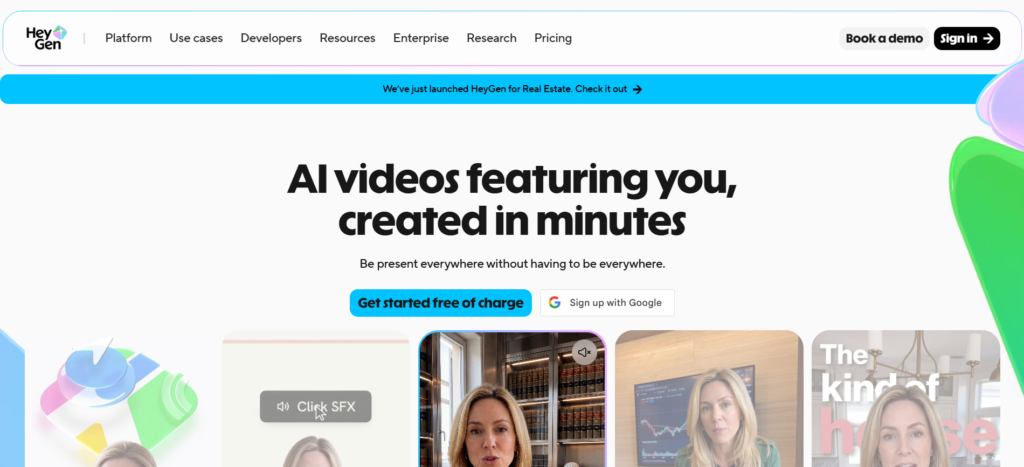
HeyGen is one of the most established platforms for creating AI avatar-led video ads. It offers a library of hundreds of realistic stock avatars, along with the ability to create custom avatars trained on real people, making it a strong option for brands that want a consistent presenter across every campaign.
The most powerful aspect of HeyGen is the way its avatars portray the script, with impeccable lip syncs and voice generation in over 30 languages. This is where HeyGen becomes exceptionally useful for global marketers who wish to localize an identical ad script in several different places.
Key Features:
- 700+ stock avatars plus custom avatar creation
- Voice cloning and AI voice generation
- Support for 30+ languages with accurate lip-syncing
- Text-to-video generation from a script
- 4K export on higher-tier plans
Pros:
- Large, realistic avatar library
- Strong multilingual and localization support
- Fast turnaround from script to finished video
- Reliable lip-sync quality
Cons:
- Credit system can be confusing, especially for premium avatar features
- Free plan is limited to short, watermarked videos
- Real cost often exceeds the advertised plan price for heavy use
- Extra seats and credits add up quickly on team plans
Pricing:
- Free: $0/month
- Creator: $29/month
- Pro: $49/month
2. Creatify
Rating: 4.5/5
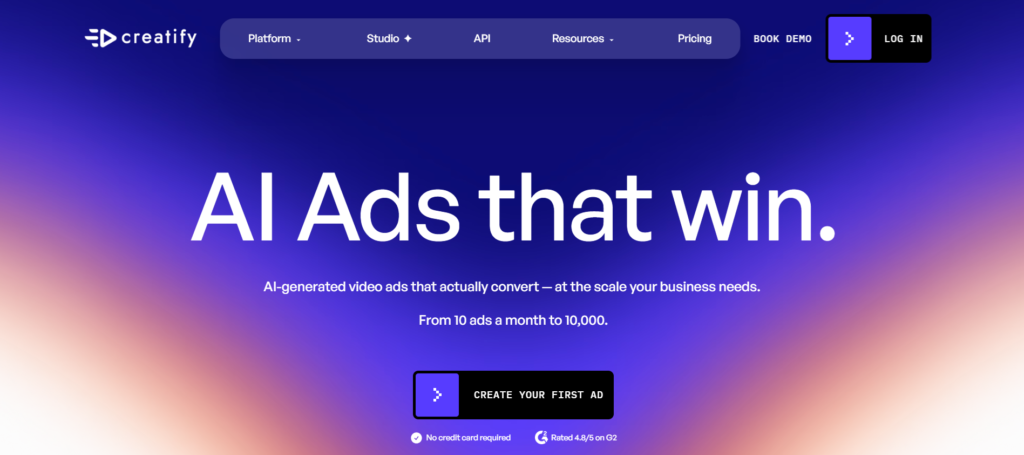
As Creatify focuses on performance marketing and e-commerce companies, this is because the application converts the simple URL of the product into a fully-fledged video ad. Enter the URL of your product on Shopify, Amazon or any other platform, and Creatify will use the data to create an ad video through artificial intelligence avatars and UGC presenters.
Beyond generation, Creatify includes an ad intelligence layer that lets users research competitor ads on Meta, plus a batch mode for generating multiple creative variations at once. This makes it particularly useful for teams running structured creative testing across several product lines simultaneously.
Key Features:
- URL-to-video ad creation from product pages
- AI script writer following proven ad frameworks
- Batch mode for generating multiple creative variations
- Competitor ad tracker searching 10M+ Meta ads
- Custom avatars and multilingual rendering
Pros:
- Fast, simple path from product page to finished ad
- Useful competitor research tools built in
- Good for testing multiple hooks and angles quickly
- Reasonably priced compared to dedicated UGC platforms
Cons:
- Credit costs vary by video length and avatar quality, which can be confusing
- Watermark remains on the entry-level Starter plan
- Custom avatars are locked to the Pro plan
- Raw AI-generated scripts often need human editing before launch
Pricing:
- Free: $0/month
- Starter: $19/month
- Pro: $49/month
- Enterprise: Custom pricing
Bonus Read: Top AI Document Generation Software for Businesses in 2026
3. Arcads
Rating: 4.2/5
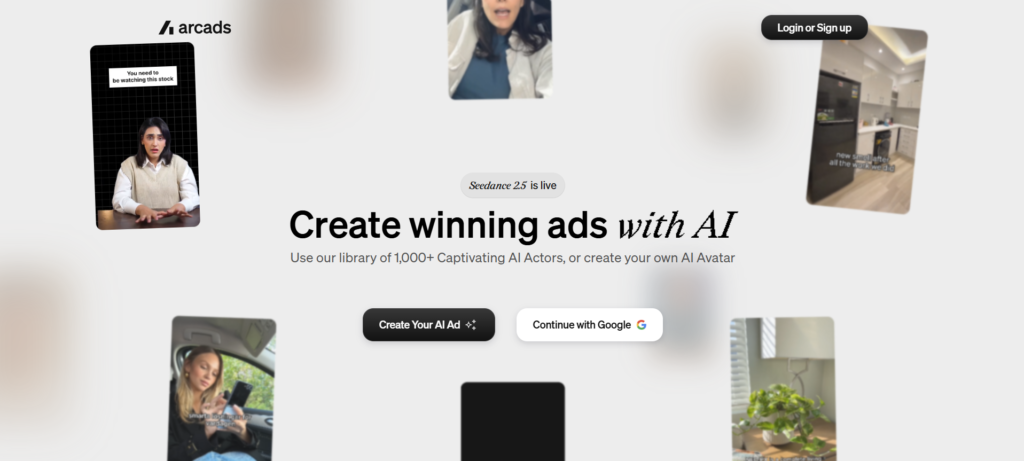
Arcads is a unique solution dedicated exclusively to video ads with user-generated content, employing a database of over 1,000 AI characters to generate an actual talking-head video ad based on a script. This tool is especially helpful to performance marketers, who conduct a large volume of hook testing on Meta and TikTok.
The basic process is easy: just write a hook, pick an actor, and then create your 30- to 60-second commercial ad in a spokesperson style in a few minutes. The diversity of actors offered by Arcads is its most outstanding feature, which makes it suitable for those who would like to try out the same script with several actors at once.
Key Features:
- 1,000+ AI actors for UGC-style presentation
- Fast script-to-video rendering
- Hook and angle testing across multiple actors
- Auto-captions and voice preview before rendering
- Custom spokesperson option on higher tiers
Pros:
- Large, realistic actor library built specifically for ad testing
- Genuinely UGC-style output rather than obviously synthetic avatars
- Fast rendering for quick creative iteration
- Strong fit for Meta and TikTok ad workflows
Cons:
- No free plan or trial to test the platform first
- One of the higher entry price points in the category
- Pricing isn’t published publicly, requiring signup to see costs
- Credit system rounds video length up, which can inflate real cost per ad
Pricing:
Arcads does not publish public pricing.
4. Runway
Rating: 4.5/5
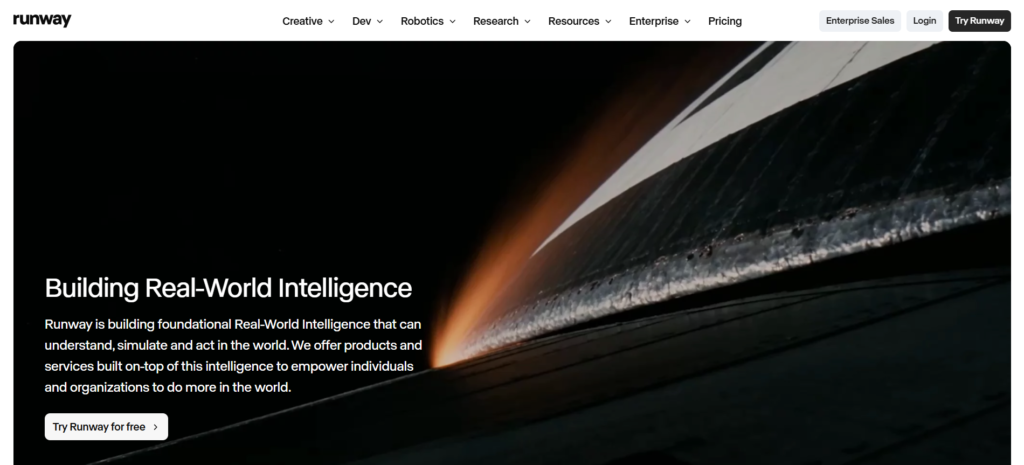
Runway works differently from other tools in this list that concentrate on avatars, being a video generation tool suitable for creating cinematic and highly stylized visuals from text descriptions. It is used by filmmakers and creative agencies but is more and more common for creating ads that require a higher level of visual style than user-generated content.
Runway’s Gen-4.5 model can generate high-quality video from text or image prompts, and its Aleph tool allows for advanced video editing and scene manipulation. For advertisers looking to create striking visual concepts, product showcases, or brand films rather than talking-head UGC ads, Runway offers creative flexibility that avatar-based tools don’t match.
Key Features:
- Gen-4.5 text-to-video and image-to-video generation
- Aleph tool for advanced video editing and scene changes
- Act-Two performance capture for stylized character animation
- 4K upscaling on higher-tier plans
- Credit-based system across multiple AI models
Pros:
- High-quality, cinematic visual output
- Flexible creative tools beyond simple ad generation
- Strong for brand films and stylized product visuals
- Frequent model updates keep quality competitive
Cons:
- Credit system can be complex and doesn’t roll over
- Not built specifically for UGC-style or avatar-led ads
- Higher-volume social ad production gets expensive quickly
- Steeper learning curve than dedicated ad-generation tools
Pricing:
- Free: $0/month
- Standard: $12/month, billed annually
- Pro: $28/month, billed annually
- Max: $76/month, billed annually
- Enterprise: Custom pricing
5. Google Veo
Rating: 4.4/5

Google Veo is the Google generative video model which can be accessed via Google AI subscriptions, Flow creative tool, and Vertex AI. Google Veo creates high-quality videos with native synchronized audio which include dialogues, ambiance sound, and effects using only text and images.
For advertisers running campaigns through Google Ads, Veo’s tight integration with Google’s broader ecosystem makes it a natural fit for producing video assets that feed directly into Demand Gen and YouTube ad campaigns. Its native audio generation sets it apart from many competitors that require separate voiceover or sound design steps.
Key Features:
- Native synchronized audio generation, including dialogue and sound effects
- Text-to-video and image-to-video generation
- Up to 4K output on higher tiers
- Scene extension for longer narrative sequences
- Vertex AI integration for enterprise and API workflows
Pros:
- Strong native audio generation built into every video
- Deep integration with Google’s advertising and cloud ecosystem
- High visual quality, especially at 1080p and above
- Flexible access through consumer plans or enterprise API
Cons:
- Credit system and per-second API pricing can be hard to predict
- Free daily credits are limited and don’t roll over
- Best value requires understanding Flow credits versus API billing
- Less specialized for UGC-style or avatar-led ad formats
Pricing:
Available through eligible Google AI plans; no standalone price listed.
Matching the Right Tool to Your Advertising Strategy
HeyGen would be your best choice in case you are targeting different locations and languages and want to have one AI host throughout your campaigns. E-commerce brands that want to move fast from product listing to finished ad should look at Creatify’s URL-to-video workflow. Performance marketers focused on high-volume UGC-style hook testing will get the most value from Arcads’ actor variety. In case your campaigns are more focused on cinematic and high-quality visual ads, Runway would be a much better choice for you. Moreover, if you are already using Google Ads or YouTube for your campaigns, then the natural integration of Google Veo will suit you best.
Features That Can Improve AI Video Ad Performance
The realism of an avatar and lip syncs become important when you want your ad to be delivered by a presenter who should convey a message effectively. The process of text-to-video conversion and URL-to-video generation helps in increasing efficiency in creating a video from idea to finished ad. The performance of UGC style videos is higher on social media than polished ads.
Creative variations let teams test multiple hooks or angles without multiplying production time, and strong voice generation with accurate lip-syncing keeps avatar-led ads from feeling uncanny.
AI Video Ads vs Traditional Ad Production
Conventional advertisement production takes several days or even weeks and costs several hundred or thousand dollars due to the hiring of actors, the rent of the studio, and the editing of materials. AI advertisement reduces the time spent on production down to several hours and decreases the expenses related to the creation of content significantly, therefore it is quite possible to create numerous variations of content for the same cost of creating one or two conventional commercials. Personalization is also more likely with AI technology since the localization of a particular ad does not require any additional production.
Understanding AI Video Advertising Costs
Most of the software in this segment is priced through a combination of free versions and pay-per-credit, in which case the amount of credits used depends on the duration of the video generated, its resolution, and the quality of the avatar. A monthly subscription model is applied, whereby the entry level is from $12-$40 per month, while professional level prices range from $50-$150 per month. Video generation limits matter more than the sticker price in many cases, since credit systems can make a “cheap” plan cover far fewer usable videos than expected.
A Practical Framework for Choosing Your Tool
Begin by outlining what your advertising objectives are, whether you want to test various hooks in a quick succession, develop a coherent brand presenter or make high-quality cinematographic imagery. Determine on which platforms you are planning to advertise, as different media has different requirements in terms of format and aspect ratios – there is a difference between advertising on TikTok, Meta or YouTube. Choose a suitable format based on your advertising approach, whether it is UGC-like talk-shows or regular product presentations.
What to Expect From AI Video Advertising in 2026
AI-generated UGC ads remain a top focus of performance marketing budgets since companies are using realistic and rough-looking creative which works well for social feed ads. The trend towards personalized video advertising is rising because of decreasing generation costs. The automation of creative testing is being implemented in such platforms since it helps advertisers test their ads without additional efforts to set them up. Moreover, AI avatar advertising becomes more realistic and multilingual ad production turns local ads into international ones.
Final Verdict
The best AI ad generator depends on your campaign goals. HeyGen is a strong overall option, while Creatify suits e-commerce campaigns and Arcads focuses on UGC advertising. Runway is better for cinematic visuals, whereas Google Veo works well for brands focused on Google Ads.
Before making your decision, make sure to compare their features, quality of the output produced, prices, and the compatibility with your working system. It is recommended to try out a couple of services.